
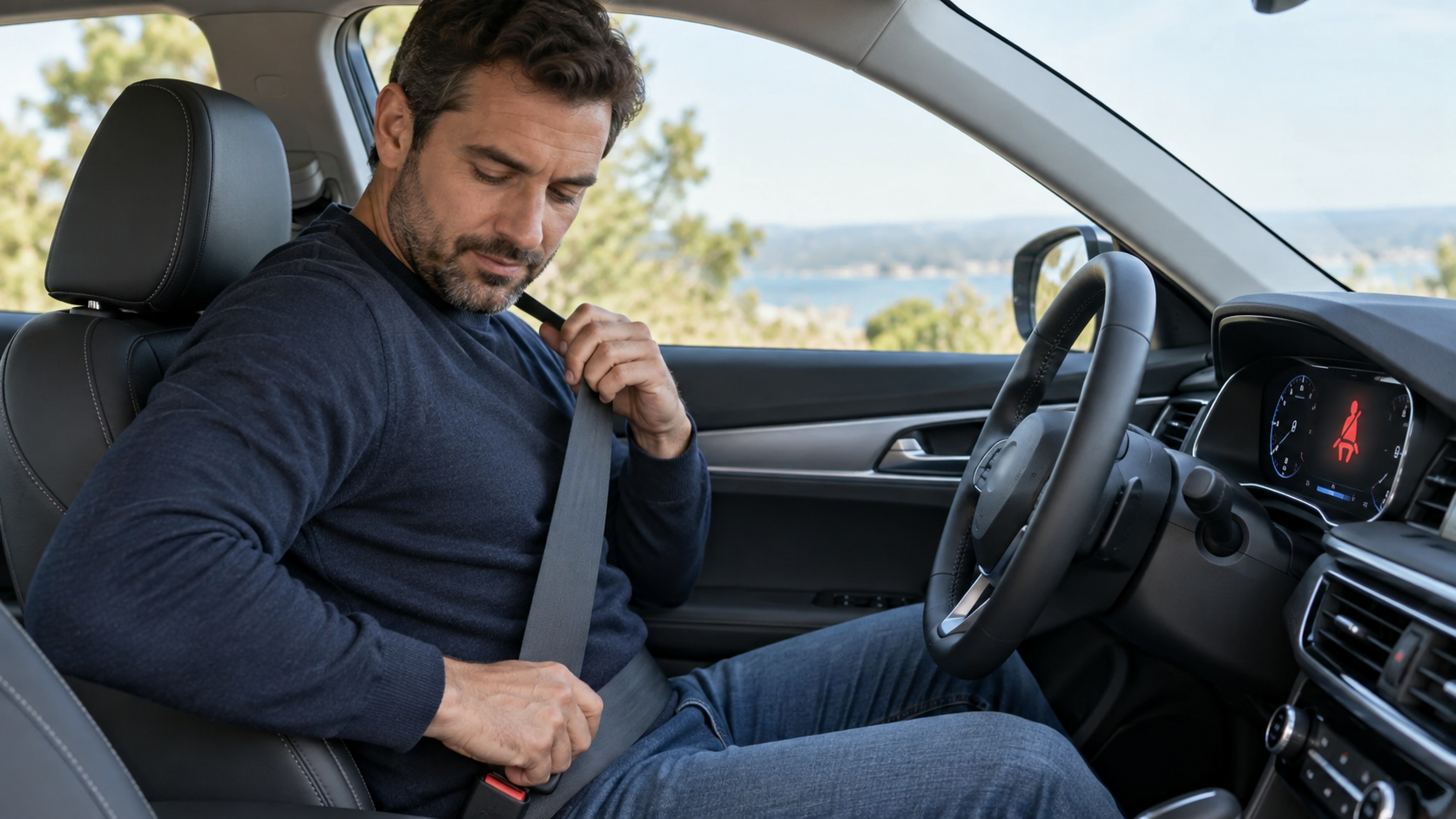
Seat belt injury claims are receiving renewed attention in 2026 as state laws continue to change and federal regulators update vehicle warning requirements. Seat belts remain one of the most important protections available to drivers and passengers, but whether a person was buckled can also become an issue after a crash. Depending on the state, an insurer or defendant may try to argue that failure to wear a seat belt contributed to the severity of an injury, even when another driver caused the collision itself.
At the same time, federal seat belt reminder rules are evolving. The National Highway Traffic Safety Administration originally established new warning requirements for front and rear seating positions, but an April 2026 interim final rule moved the compliance date to September 1, 2028. These developments make seat belt use, reminder technology, and post-crash evidence increasingly important topics for drivers, passengers, insurers, and injury claimants.
Why Seat Belt Laws Are Getting Attention in 2026
Seat belt requirements are not identical across the United States. States decide many of their own rules governing who must buckle up, whether police may stop a vehicle solely for a seat belt violation, and how nonuse may affect a civil injury claim.
The National Conference of State Legislatures has tracked important recent legislative developments involving seat belt laws. Changes in some states may affect whether failure to wear a seat belt can be considered in civil actions involving negligence, causation, comparative fault, or damages.
These changes are important because a seat belt issue can involve two separate questions. The first is who caused the crash. The second is whether seat belt use or nonuse affected the injuries suffered in the collision. Those questions should not automatically be treated as the same thing.
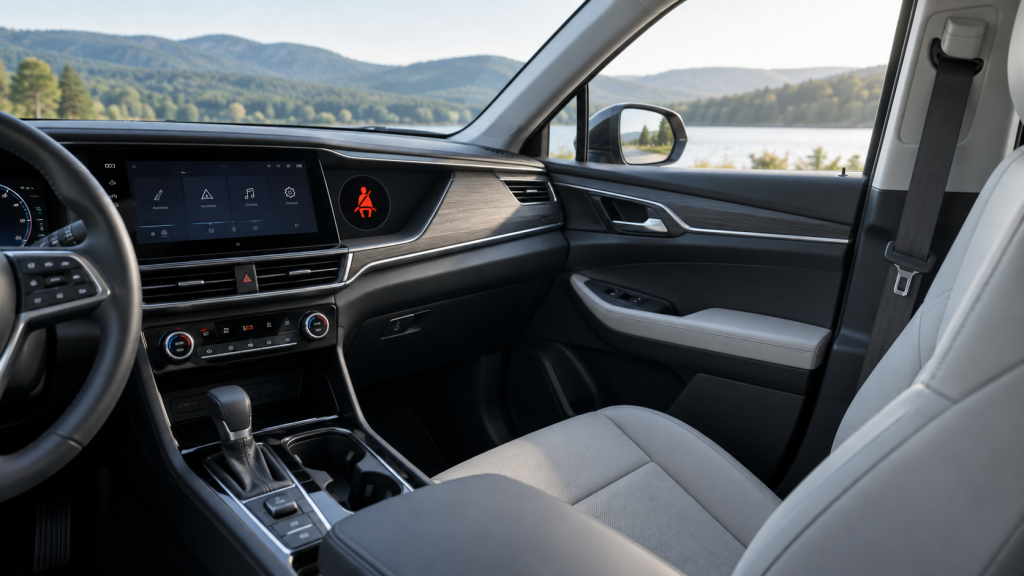
Seat Belt Nonuse Does Not Automatically Cause the Crash
A driver who runs a red light, follows too closely, speeds, or makes an unsafe lane change may still be responsible for causing a collision even if an injured person was not wearing a seat belt. Seat belt use generally relates more directly to occupant protection after impact than to the conduct that caused two vehicles to collide.
However, some states allow defendants to introduce evidence that an injured occupant was unrestrained and argue that the injuries would have been less severe with proper belt use. Other states restrict or prohibit this type of argument. Because the rules vary considerably, a seat belt injury claim should be evaluated under the law of the state where the accident occurred.
The distinction can become important during settlement negotiations. An insurer may accept that its insured caused a crash but still argue that part of the claimed injury resulted from the occupant’s failure to buckle up. Whether that argument is legally available and how much it may affect damages are state-specific questions.
Why Seat Belts Matter From a Safety Perspective
The safety value of seat belts is well established. According to NHTSA’s seat belt safety information, seat belts significantly reduce the risk of fatal and serious injuries for passenger vehicle occupants.
Seat belts help keep occupants inside the vehicle, distribute crash forces across stronger parts of the body, and work together with airbags. NHTSA emphasizes that airbags are designed to supplement seat belts rather than replace them.
Federal Seat Belt Reminder Rules Have Also Changed
Federal vehicle standards are changing as regulators try to increase belt use through stronger reminder systems. NHTSA finalized expanded warning requirements that would apply to the driver, front passenger, and eventually rear occupants.
However, NHTSA later reconsidered the implementation schedule. In an April 2026 interim final rule, the agency delayed the compliance date for the updated requirements to September 1, 2028, with optional early compliance permitted.
The earlier NHTSA seat belt reminder rule announcement explains that the updated standards are intended to increase belt use by strengthening visual and audible reminders for occupants.
The delay does not mean seat belt reminders are disappearing. Many current vehicles already include voluntary reminder systems that go beyond older minimum requirements. It means manufacturers have additional time before every covered vehicle must meet the revised federal standard.
Seat Belt Systems Can Become Important Crash Evidence
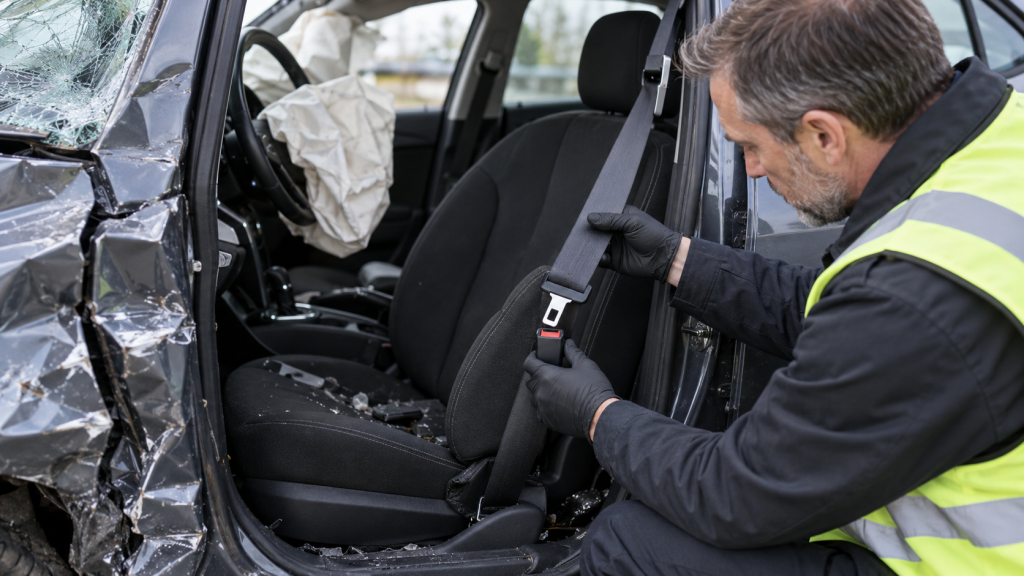
After a serious collision, investigators may examine more than whether a person says they were wearing a seat belt. Modern vehicles can preserve physical and electronic evidence related to restraint use.
The buckle and latch may show marks or loading consistent with crash forces. Seat belt webbing may contain stretching, abrasion, or other physical signs. Pretensioners are designed to tighten the belt rapidly during certain crashes and may deploy along with airbags. Some vehicles may also record seat belt status in event data associated with the collision.
This is one reason a damaged vehicle should not always be repaired, dismantled, or destroyed immediately after a serious injury crash. Our guide on how smart car data can help prove fault after a crash explains how event data recorders and other vehicle systems may preserve information related to braking, speed, restraint use, and airbag deployment.
What If the Seat Belt Itself Failed?
Not every restraint-related injury involves nonuse. In some crashes, an occupant may have been properly buckled but the belt system allegedly failed to perform as intended. Possible concerns may include a buckle that releases, damaged webbing, an ineffective pretensioner, improper mounting, or another component issue.
When a restraint system is suspected of malfunctioning, preserving the vehicle becomes especially important. The buckle, latch plate, webbing, anchor points, pretensioner, airbag module, seats, and electronic data may all be relevant to an investigation.
Vehicle owners can also check the NHTSA recall database to determine whether a vehicle or restraint component has an open safety recall. The existence of a recall does not automatically prove that a particular crash injury resulted from the recalled condition, but it may provide useful information for further investigation.
How Insurance Companies May Handle Seat Belt Questions
Insurance adjusters commonly ask about how a crash happened, where people were seated, whether airbags deployed, and whether occupants were wearing seat belts. These questions can relate to the mechanics of the crash, the claimed injuries, and the insurer’s evaluation of damages.
Claimants should answer factual questions truthfully and avoid guessing. If someone does not clearly remember whether a belt was fastened, physical vehicle evidence, police documentation, medical records, witness statements, photographs, and electronic data may provide additional information.
It is also important to preserve original crash photographs. Edited or AI-altered images can create questions about authenticity. Our article on AI-generated accident evidence explains why original files and metadata should be retained whenever possible.
What Evidence Should Be Preserved?
A seat belt injury claim may depend on several forms of evidence rather than a single statement about restraint use. Important records may include the police crash report, photographs of the vehicle interior, photographs of the buckle and belt, event data recorder information, airbag records, medical documentation, witness statements, emergency response records, and vehicle inspection findings.
When the vehicle is badly damaged, an inspection may need to occur before an insurer or salvage company disposes of it. Once the vehicle has been crushed or key components have been removed, some evidence may be impossible to recreate.
Digital information should also be backed up. Dashcam recordings, connected vehicle records, smartphone photographs, and insurer communications can be useful later if the parties disagree about what occurred.
Seat Belt Laws Still Vary From State to State
Drivers should not assume that the same rules apply everywhere. Some states use primary enforcement, allowing an officer to stop a vehicle for a seat belt violation alone. Others apply different enforcement rules or exemptions depending on seating position, age, or vehicle type.
NHTSA explains the distinction between primary and secondary enforcement in its seat belt law guidance.
Civil rules can vary just as much. A state may allow evidence of nonuse for limited purposes, restrict it, or exclude it entirely. Recent legislative activity illustrates why older assumptions about the so-called seat belt defense may no longer be reliable without checking current law.
Steps to Consider After a Crash
- Get appropriate medical care. Report symptoms accurately and follow medical recommendations.
- Photograph the vehicle. Include both exterior damage and the passenger compartment when it is safe to do so.
- Preserve the seat belt system. Avoid unnecessary repair or disposal before important evidence is evaluated.
- Save digital records. Back up photographs, video, vehicle data, app information, and insurance communications.
- Check current law. Seat belt rules and the use of nonuse evidence vary by state.
- Check for recalls. Determine whether the vehicle or restraint system is affected by an open safety recall.
Why Seat Belt Safety Remains a National Priority
Seat belt use continues to be a major federal safety priority. NHTSA regularly promotes its Click It or Ticket campaign to encourage drivers and passengers to buckle up on every trip.
Technology can encourage safer behavior, but reminder chimes and dashboard icons do not replace the decision to buckle up correctly. Drivers should also make sure passengers are restrained and that children use appropriate child restraints for their age and size.
Frequently Asked Questions
Can I Still Have an Injury Claim If I Was Not Wearing a Seat Belt?
Potentially. Not wearing a seat belt does not automatically mean another driver was not responsible for causing the crash. However, in some states, nonuse may be considered when determining whether certain injuries could have been reduced or prevented.
Can an Insurer Automatically Reduce My Claim Because I Was Unbuckled?
Not necessarily. Whether seat belt nonuse is legally relevant depends on state law, the available evidence, and the injuries involved. An insurer’s position does not by itself determine the final legal result.
Can Vehicle Data Show Whether a Seat Belt Was Fastened?
Some vehicles may record restraint-related information, including belt status, as part of crash data. The available information depends on the vehicle and system involved.
Are New Seat Belt Reminder Requirements Already Mandatory on Every 2026 Vehicle?
No. NHTSA’s April 2026 interim final rule moved the federal compliance date for the revised seat belt reminder requirements to September 1, 2028, although manufacturers may comply earlier.
Final Thoughts
Seat belt injury claims sit at the intersection of traffic safety, vehicle technology, state negligence law, and insurance practice. Changes in 2026 show why current legal information matters. A person may still be able to pursue an injury claim even when seat belt use becomes disputed, but the effect of that issue depends on the state, the evidence, and the specific injuries involved.
Preserving the vehicle, digital crash records, original photographs, medical documentation, and restraint system evidence can help provide a clearer picture of what happened.
For additional information about crashes, evidence, and insurance issues, explore the John Scott Law car accident guides or visit our legal blog and insights.